
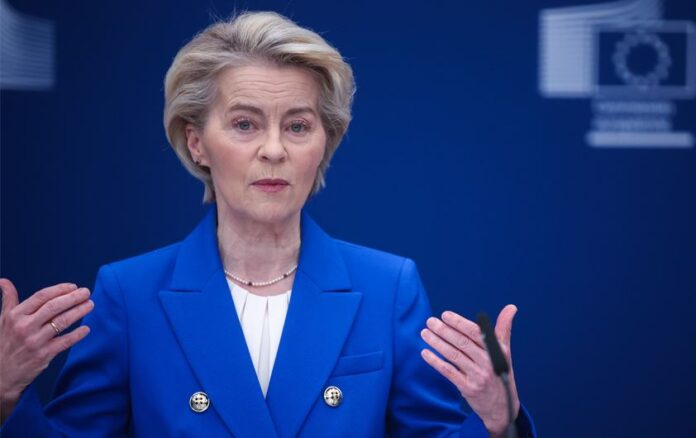
OFFICIAL LETTER OF STRONG PROTEST REGARDING THE STATEMENTS MADE BY EUROPEAN COMMISSION PRESIDENT URSULA VON DER LEYEN IN SKOPJE – DEMAND FOR IMMEDIATE CLARIFICATIONS AND RESPECT FOR THE HISTORICAL AND CULTURAL HERITAGE OF MACEDONIA
Dear Madam President,
The Panhellenic Federation of Cultural Associations of Macedonians (POPSM), representing cultural associations dedicated to preserving and promoting the historical and cultural heritage of Macedonia, hereby expresses its strongest protest and profound indignation regarding the statements made by the President of the European Commission, Ms Ursula von der Leyen, during her visit to Skopje on 2 October 2026.
Ms von der Leyen stated that the European Union welcomes the neighbouring country “with its identity and language”, adding that “Macedonian culture and the Macedonian language” can make the European Union richer.
Such statements, when made without any reference whatsoever to the necessary historical and cultural distinctions, are unacceptable and deeply offensive to the Macedonian Greeks.
The President of the European Commission is not an uninformed political figure. She is fully aware of the historical sensitivities, disputes and provisions of the Prespa Agreement. She is also aware that Macedonia constitutes an integral part of Greek history and that the ancient Macedonian heritage is inseparably linked to Greek civilisation.
Consequently, the public use of such terminology without clear qualification cannot be regarded as an innocent diplomatic expression.
We refuse to accept the creation of misleading impressions that blur the distinction between the contemporary cultural identity of the neighbouring state and the Greek historical heritage of Macedonia.
Article 7 of the Prespa Agreement itself explicitly distinguishes between the meanings of the terms “Macedonia” and “Macedonian” as used by the two contracting parties. It also recognises that the official language of the neighbouring state belongs to the group of South Slavic languages and is unrelated to ancient Greek civilisation and the historical heritage of Greek Macedonia.
How is it possible for the head of the European Commission to invoke the Prespa Agreement while simultaneously omitting these crucial distinctions?
The European Union has no right to treat the historical memory of a Member State as an expendable element of its enlargement policy.
European integration cannot advance through historical ambiguities, diplomatic expediency and one-sided statements that provoke legitimate reactions.
Macedonia is not a bargaining instrument for Brussels. Its history cannot be adjusted to accommodate the changing geopolitical objectives of the European Commission.
At the same time, as a Federation, we cannot remain silent regarding the grave political responsibilities borne by the Greek political establishment.
The Prespa Agreement was not imposed upon Greece by Ms von der Leyen. It was signed by a Greek government and ratified by the Hellenic Parliament, despite widespread public opposition and the massive demonstrations that had preceded its ratification.
Subsequent Greek governments assumed responsibility for managing an already ratified agreement, while bearing their own political responsibility for defending Greek positions and confronting any attempt to create historical confusion.
It is unacceptable for the Greek political leadership to confine itself to occasional expressions of protest when the consequences of its decisions and political choices are now becoming apparent at the highest levels of the European institutions.
Historical responsibility does not disappear behind diplomatic announcements and vague assurances.
POPSM emphasises that its protest is not directed against the right of any people to preserve their language, traditions and contemporary cultural identity.
It is directed against ambiguity, historical confusion and the absence of the respect owed to Greek Macedonia.
FOR THESE REASONS, WE DEMAND:
- An immediate and official statement by the European Parliament regarding the remarks made by the President of the European Commission and the issues of historical and cultural accuracy arising from them.
- Written clarifications from the European Commission concerning the precise meaning of the terms “Macedonian culture” and “Macedonian language” as used during the visit to Skopje.
- Explicit confirmation that the European institutions fully recognise and respect the distinctions established by Article 7 of the Prespa Agreement, particularly regarding Greek history, ancient Macedonian civilisation and the cultural heritage of Greek Macedonia.
- The avoidance, in future, of ambiguous or one-sided statements by senior European officials that could be interpreted as equating historical Greek Macedonia with the contemporary identity of the neighbouring state.
- The forwarding of this formal protest to the European Commission and the competent committees of the European Parliament, ensuring official institutional awareness and the possibility of further examination.
- A written response addressed to POPSM, clearly outlining the actions that the competent European institutions intend to undertake.
Madam President,
Europe was not built to diminish the history of its peoples, nor to impose silence upon those who defend their cultural heritage.
The respect for diversity invoked by Ms von der Leyen must also apply to Macedonian Greeks.
We refuse to accept a Europe that demands that Greeks respect every other identity while treating their own historical sensitivities as an inconvenient detail.
We are not asking for preferential treatment.
We demand historical accuracy, institutional respect and equal treatment.
POPSM will continue to defend, through every lawful, democratic and institutional means, the historical truth and cultural legacy of Macedonia.
The history of Macedonia cannot be erased, distorted or surrendered through diplomatic formulations.
We await your official response.
Yours sincerely,
For the Board of Directors of the Panhellenic Federation of Cultural Associations of Macedonians (POPSM)
The President
Theodoros Charanidis